The first time I claimed on my car insurance, a scraped bumper and a broken headlamp in a Kochi parking lot, the workshop bill was ₹38,000. The insurer paid around ₹24,000. When I asked why, the surveyor pointed to one word on the assessment sheet: depreciation. That was the day I started paying for zero depreciation car insurance, and I haven’t skipped it since.
Still, it isn’t right for every car or every driver. This guide explains how depreciation eats into your claim, what the add-on actually covers, where it falls short and how to decide whether the extra premium makes sense for you.
Key Takeaways
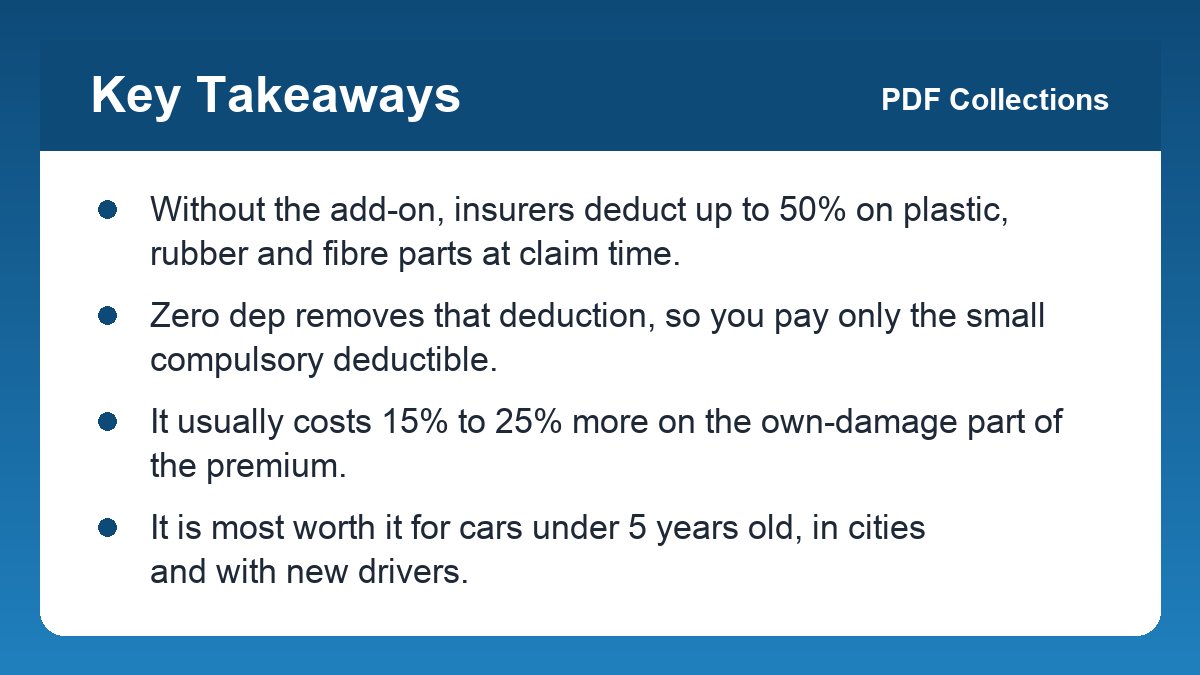
- Without the add-on, insurers deduct up to 50% on plastic, rubber and fibre parts at claim time.
- Zero dep removes that deduction, so you pay only the small compulsory deductible.
- It usually costs 15% to 25% more on the own-damage part of the premium.
- It is most worth it for cars under 5 years old, in cities and with new drivers.
Table of Contents
How Depreciation Reduces Your Car Insurance Claim
A comprehensive policy has two parts: third-party liability (compulsory by law) and own damage, which pays to repair your own car. When a part is replaced under an own-damage claim, the insurer assumes the old part had already worn out a bit. So it pays only the “depreciated” value of the new part.
Under the standard motor tariff rules that insurers still follow, the deductions look like this:
- Rubber, nylon and plastic parts, tyres, tubes and batteries: 50%
- Fibreglass parts: 30%
- Glass parts: nil
- Metal parts: based on the car’s age, from nil for cars under 6 months to 50% for cars over 10 years
For metal parts, the scale typically goes 5% for 6 months to 1 year, 10% for 1 to 2 years, 15% for 2 to 3 years, 25% for 3 to 4 years, 35% for 4 to 5 years and 40% for 5 to 10 years. Paint is also partly depreciated. Bumpers, headlamp housings and most interior panels today are plastic, so the 50% hit lands on the parts that break most often.
What Zero Depreciation Car Insurance Actually Does
The add-on simply removes those deductions. If a bumper costs ₹12,000 to replace, a normal policy might pay ₹6,000. With zero dep, the insurer pays the full ₹12,000, and you pay only the compulsory deductible.
It’s sometimes called nil depreciation or bumper-to-bumper cover. Same thing. It works only with a comprehensive or standalone own-damage policy, never with third-party-only cover.
A Real-World Example
Let’s take a three-year-old hatchback with damage after a minor collision:
- Plastic parts (bumper, grille, lamp housing): ₹18,000, minus 50% = ₹9,000 paid
- Metal parts (bonnet, fender): ₹14,000, minus 25% = ₹10,500 paid
- Glass (headlamp lens): ₹3,000, paid in full
- Labour and paint: ₹8,000, mostly paid
Without zero dep, the insurer might pay about ₹29,000 of a ₹43,000 bill, minus the ₹1,000 compulsory deductible. With zero dep, it would pay about ₹42,000. That’s a difference of roughly ₹13,000 on a single, fairly ordinary claim. The add-on on that car might cost ₹3,000 to ₹5,000 a year.
What It Doesn’t Cover
This is where people get confused and angry at claim time. Zero dep does not pay for:
- Engine damage from water (hydrostatic lock). You need an engine protection add-on.
- Normal wear and tear or mechanical and electrical breakdown.
- Tyres and tubes, unless they’re damaged in the same accident that damaged the car.
- The compulsory deductible, usually ₹1,000 for cars up to 1,500cc and ₹2,000 above.
- Damage while driving drunk or without a valid licence.
- Claims beyond the yearly limit, which is often two claims per policy year.
Read the add-on wording on your insurer’s website. It’s usually just a page or two.
Who Should Buy It?
I’d strongly consider zero dep if:
- Your car is less than 5 years old
- You drive in a busy city where small scrapes are common
- Your car is expensive to repair, like a premium sedan, SUV or an EV with costly parts
- There’s a new or young driver in the family
- You park on the street or in crowded basements
When you could skip it
- Your car is more than 7 or 8 years old and its market value is low
- You drive rarely, on quiet roads, and are happy to pay small repairs yourself
- You’d rather save the premium and protect your No Claim Bonus by not claiming small damages
How Much Does the Zero Dep Add-On Cost?
As a rough guide, the add-on raises the own-damage part of your premium by about 15% to 25%, and more for luxury cars or older vehicles. It doesn’t touch the third-party part, which is fixed by regulation.
Some tips to keep the cost down:
- Compare renewal quotes from three or four insurers. Prices for the same add-on vary a lot.
- Don’t over-declare or under-declare the car’s IDV (insured declared value). Too low means less payout if the car is stolen or totalled.
- Keep your No Claim Bonus. It discounts the own-damage premium by 20% to 50%.
- Choose a plan with the claim limit you’ll actually use. If you rarely claim, two claims a year is plenty.
Zero Dep and Your No Claim Bonus
Zero dep doesn’t protect your NCB. If you claim, your bonus resets at renewal whether or not you have the add-on. For small damages, compare the repair bill with the NCB you’d lose. On a ₹6,000 repair, it can be cheaper to pay yourself and keep a 35% or 45% NCB.
If you want both, look at the separate NCB protection add-on, which lets you make one or two claims a year without losing the bonus.
Other Add-Ons That Pair Well with It
- Engine protection: important in Kerala, Mumbai, Chennai and anywhere roads flood in the monsoon.
- Return to invoice: pays the full invoice price, not just IDV, if a new car is stolen or totalled.
- Roadside assistance: towing, flat tyre help and battery jump-start.
- Consumables cover: pays for nuts, bolts, oil, coolant and similar items that zero dep excludes.
Pick the ones that match your risks. Buying every add-on can double the premium.
How to Claim Smoothly
- Inform the insurer immediately, through the app or helpline, before moving the car to a workshop if possible.
- Take clear photos of the damage and the spot.
- File an FIR for theft, major accidents or third-party injury.
- Use a network garage for cashless repair.
- Check the survey report and make sure “nil depreciation” is applied to the parts.
If something goes wrong, escalate to the insurer’s grievance team first, then to IRDAI’s Bima Bharosa portal or the Insurance Ombudsman.
The Bottom Line
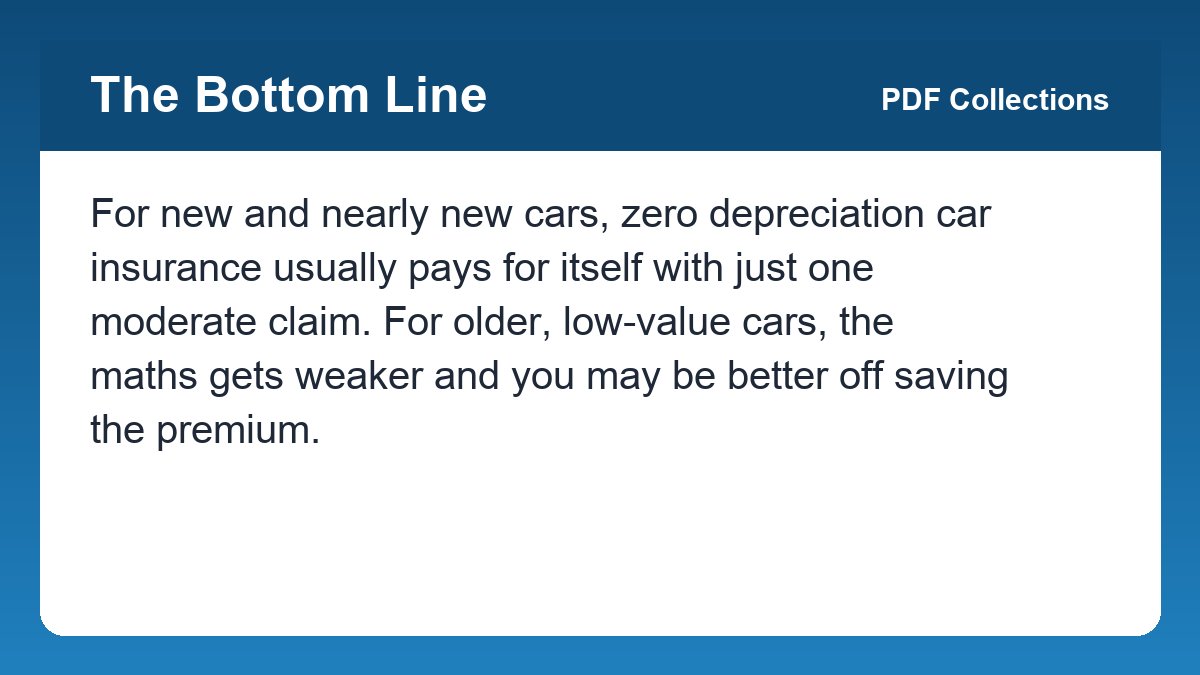
For new and nearly new cars, zero depreciation car insurance usually pays for itself with just one moderate claim. For older, low-value cars, the maths gets weaker and you may be better off saving the premium. Look at your car’s age, where you drive and how often you’ve claimed in the past, then decide.
And if you’re reviewing your other family policies at the same time, our guide to PMJAY health insurance is worth a look for older family members.
Sources and Further Reading
Frequently Asked Questions
Is zero depreciation the same as bumper-to-bumper cover?
Yes. Zero depreciation, nil depreciation and bumper-to-bumper are different names for the same add-on. It removes the depreciation deduction on replaced parts when you make an own-damage claim.
Up to what car age can I buy zero dep cover?
Most insurers sell it for cars up to 5 years old, and some extend it to 7 years or more for well-maintained cars. Availability varies by insurer, so check at renewal time.
Does zero depreciation cover engine damage from flooding?
No. Engine damage caused by water entering the engine is usually treated as consequential damage and is excluded. You need a separate engine protection add-on for that.
Will I still pay something from my pocket at claim time?
Yes. You still pay the compulsory deductible, typically ₹1,000 for cars up to 1,500cc and ₹2,000 above that, plus any voluntary deductible you chose and costs of items the policy does not cover.
How many claims are allowed under zero dep?
Many insurers limit zero depreciation to two claims per policy year, though some allow more or unlimited claims at a higher price. After the limit, normal depreciation applies.
This article is for general information only and is not insurance, financial or legal advice. Coverage, prices and rules vary by insurer and location, so always check your policy documents or talk to a licensed agent before making a decision.