Last year my uncle in Thrissur spent eleven days in hospital after a mild stroke. The bill came to a little over ₹4.2 lakh. He had a health policy, but it had a 20% co-pay and a room rent limit nobody in the family had noticed. He ended up paying almost ₹1.3 lakh from his savings. The policy wasn’t bad. It just wasn’t understood.
That is the real problem with health insurance for senior citizens. Plans for older people come with conditions that don’t appear in younger people’s policies. This guide explains the rules in plain language so you can pick a policy for your parents without nasty surprises when a claim comes.
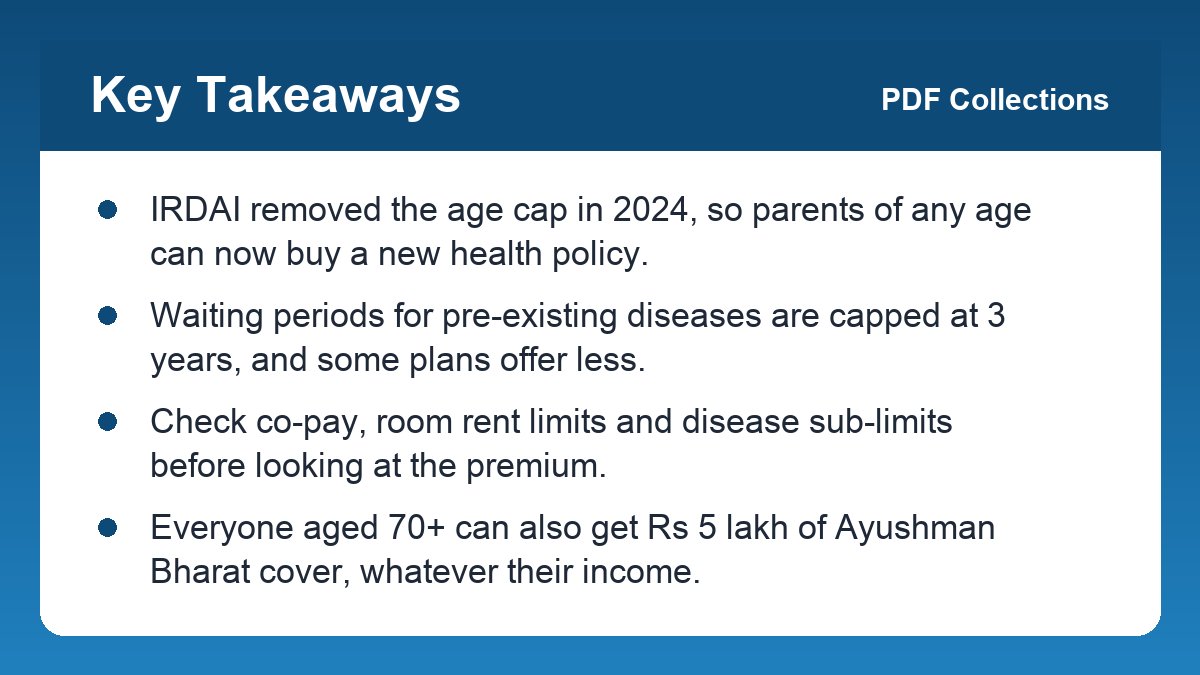
Key Takeaways
- IRDAI removed the age cap in 2024, so parents of any age can now buy a new health policy.
- Waiting periods for pre-existing diseases are capped at 3 years, and some plans offer less.
- Check co-pay, room rent limits and disease sub-limits before looking at the premium.
- Everyone aged 70+ can also get ₹5 lakh of Ayushman Bharat cover, whatever their income.
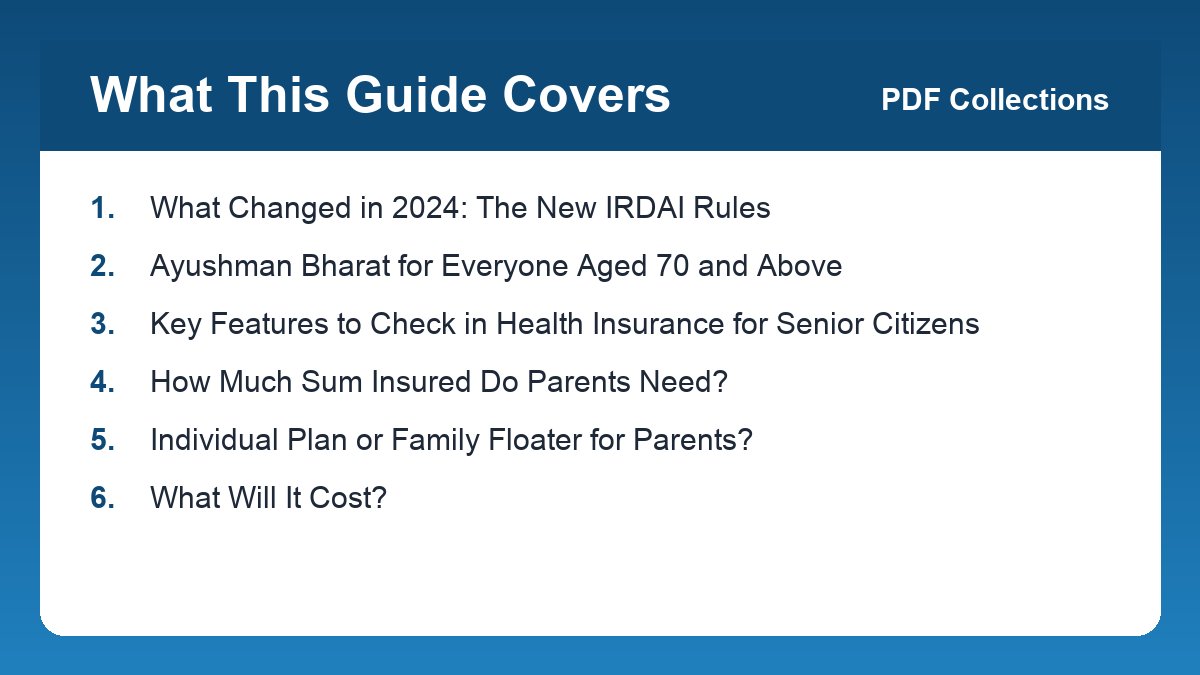
Table of Contents
What Changed in 2024: The New IRDAI Rules
A few big changes from the insurance regulator, IRDAI, made buying cover for older parents much easier:
- No age limit to buy. Earlier, many insurers stopped selling new policies after age 65. That cap has gone. Insurers can now sell health cover to people of any age.
- Shorter waiting period for pre-existing diseases. The maximum is now 3 years, down from 4.
- Moratorium cut to 5 years. After 5 continuous years of cover, an insurer can’t reject a claim for non-disclosure, except in cases of proven fraud.
- Faster cashless decisions. Insurers are expected to approve cashless requests quickly and finalise discharge within hours, not days.
Underwriting is still up to each insurer. A 74-year-old with uncontrolled diabetes may be asked for tests, offered a co-pay plan or quoted a high premium. But the door is no longer shut.
Ayushman Bharat for Everyone Aged 70 and Above
In October 2024 the government extended Ayushman Bharat PM-JAY to every Indian aged 70 or above, regardless of income. Each eligible senior can get up to ₹5 lakh of cover a year for hospital treatment at empanelled hospitals, using the Ayushman Vay Vandana card.
It’s a huge help, especially for families who couldn’t afford private premiums. But it has limits. You must use an empanelled hospital, and the list of good private hospitals varies a lot by district. If your parents already have private cover, they can keep both.
We have a separate, detailed guide to PMJAY health insurance that explains how to check eligibility and get the card.
Key Features to Check in Health Insurance for Senior Citizens
When I compare plans for parents, I ignore the brochure headlines and go straight to these points in the policy wording.
1. Co-payment
Many senior plans have a compulsory co-pay of 10%, 20% or even 30%. On a ₹5 lakh bill, a 20% co-pay means you pay ₹1 lakh. A plan without co-pay costs more, but it’s often worth it if your parents have heart or kidney issues.
2. Room rent limit
Some policies cap room rent at 1% of the sum insured per day, or allow only a shared room. If your parent takes a bigger room, the insurer may cut all related costs (doctor fees, nursing, tests) in the same ratio. This “proportionate deduction” is how most people lose money. Look for “no room rent limit” or “single private room”.
3. Disease-wise sub-limits
Cataract, knee replacement, hernia and prostate surgery often have fixed caps. Cataract is extremely common after 60, so check that cap carefully.
4. Waiting periods
There are usually three: a 30-day initial wait, a 1 to 2 year wait for specific illnesses and up to 3 years for pre-existing conditions like diabetes or hypertension. Some insurers sell an add-on that cuts the pre-existing wait to one year.
5. Pre- and post-hospitalisation cover
Good plans pay for tests and medicines 30 to 60 days before admission and 60 to 180 days after discharge. For older people, the post-discharge medicine bill alone can be large.
6. Day-care and home treatment
Many treatments, like chemotherapy, dialysis and cataract surgery, don’t need a 24-hour stay. Make sure day-care procedures are covered. Domiciliary (home) treatment is a bonus.
7. Network hospitals near your parents
Search the insurer’s website for cashless hospitals in your parents’ town, not just the nearest metro. A good plan with no network hospital nearby is frustrating in an emergency.
How Much Sum Insured Do Parents Need?
Hospital costs keep rising, and older patients tend to stay longer. In a tier-2 city, ₹5 lakh is a sensible minimum for each parent. In a metro, or if a parent has heart disease, aim for ₹10 lakh or more.
A cheaper way to get high cover is a base policy plus a super top-up. For example, a ₹5 lakh base plan with a ₹15 lakh super top-up (deductible ₹5 lakh) gives ₹20 lakh of protection. The top-up costs much less than a ₹20 lakh base plan because it only kicks in after the first ₹5 lakh of claims in a year.
Individual Plan or Family Floater for Parents?
Don’t add parents to your own family floater. Floater premiums are based on the oldest member, so including a 68-year-old parent will push up the premium for your whole family. Worse, one big claim for a parent can use up the cover meant for your children.
A separate senior citizen plan, or an individual plan for each parent, is usually the better structure. For a couple, a two-adult floater just for the parents can also work.
What Will It Cost?
Premiums depend on age, city, sum insured, co-pay and medical history. As a very rough idea, a ₹5 lakh policy for a healthy 65-year-old might cost somewhere between ₹20,000 and ₹40,000 a year, and more for higher ages or pre-existing illness. Since 22 September 2025, individual health insurance premiums are exempt from GST, which has brought prices down slightly.
Ways to keep the cost reasonable:
- Accept a modest co-pay (10%) if your parents are in good health.
- Use a base plan plus super top-up rather than one big plan.
- Pay for two or three years in one go, as many insurers give a small discount.
- Buy before a parent develops a new condition. Premiums and exclusions only get worse.
Documents and Medical Tests
For a new senior citizen policy you’ll usually need:
- Aadhaar and PAN (or other ID and address proof)
- Recent photograph
- Past medical records, prescriptions and discharge summaries
- Pre-policy medical tests, often paid by the insurer, for people above 55 to 60
Disclose every condition, every regular medicine and any past surgery, even if it seems minor. Claims are most often rejected because something was left out of the proposal form.
Mistakes to Avoid with Health Insurance for Senior Citizens
- Choosing the cheapest plan without reading the wording. Low premium often means high co-pay and tight sub-limits.
- Letting the policy lapse. Renew on time. A break resets waiting periods and the 5-year moratorium.
- Relying only on a company group policy. Parents’ cover under your employer ends when you leave the job.
- Ignoring porting. If your parents’ current plan is poor, you can port it to another insurer and keep the waiting period credit you’ve earned.
- Not keeping a claim file. Store the policy number, TPA helpline and network hospital list somewhere your parents can find them.
Tax Benefits for Your Parents’ Premium
If you file under the old tax regime, premiums you pay for your parents’ health insurance qualify for a separate deduction, on top of the deduction for your own family. The limit is higher when a parent is a senior citizen. Preventive health check-ups also count, within the limit. The new tax regime doesn’t allow this deduction, so it only helps if the old regime still suits you.
The Bottom Line
Buying cover for older parents is easier than it used to be, thanks to the 2024 rules and Ayushman Bharat for over-70s. The real work is reading the fine print: co-pay, room rent, sub-limits and waiting periods. Get those right, pick a sum insured that matches local hospital costs, and renew without fail every year.
Spend one weekend comparing policies. It may save your family lakhs later, and it’ll give your parents some peace of mind too.
Sources and Further Reading
- IRDAI: Insurance Regulatory and Development Authority of India
- National Health Authority: Ayushman Bharat PM-JAY
Frequently Asked Questions
Is there an upper age limit to buy health insurance in India?
Not anymore at the regulatory level. In 2024 IRDAI removed the old age cap, so insurers can now sell new health policies to people of any age. Each insurer still decides its own underwriting, so older applicants may face medical tests, co-pay or higher premiums.
How long is the waiting period for pre-existing diseases?
Under IRDAI's 2024 rules the waiting period for pre-existing diseases can be at most 3 years. Many senior citizen plans offer shorter waits, sometimes 1 or 2 years, often for a higher premium.
What is co-payment in a senior citizen health policy?
Co-payment means you pay a fixed share of every claim yourself, commonly 10% to 30%, and the insurer pays the rest. Policies with co-pay are cheaper, but you should be sure you can afford your share of a large hospital bill.
Can my parents use Ayushman Bharat instead of private insurance?
Since late 2024, every Indian aged 70 or above can get Ayushman Bharat PM-JAY cover of up to ₹5 lakh a year, regardless of income. It is valuable, but it only works at empanelled hospitals, so many families keep a private policy as well.
Can I claim tax benefits on my parents' health insurance premium?
Under the old tax regime, premiums paid for parents' health insurance qualify for a separate deduction, with a higher limit if a parent is a senior citizen. The new tax regime does not offer this deduction, so check which regime you file under.
This article is for general information only and is not insurance, financial or legal advice. Coverage, prices and rules vary by insurer and location, so always check your policy documents or talk to a licensed agent before making a decision.