The week I landed in Abu Dhabi, my bank in Kerala sent me a polite but firm letter: my savings account had to be converted, and I needed to choose between an NRE and NRO account. I picked one almost at random, and it took me two years to realise I’d been parking my rent income in the wrong place. If you’re facing the same choice, this comparison of NRE vs NRO account rules should save you that confusion.
The short version: the NRE account is for money you earn abroad, and the NRO account is for money you earn in India. But the details, especially around tax and sending money back abroad, are where it really matters.
Key Takeaways
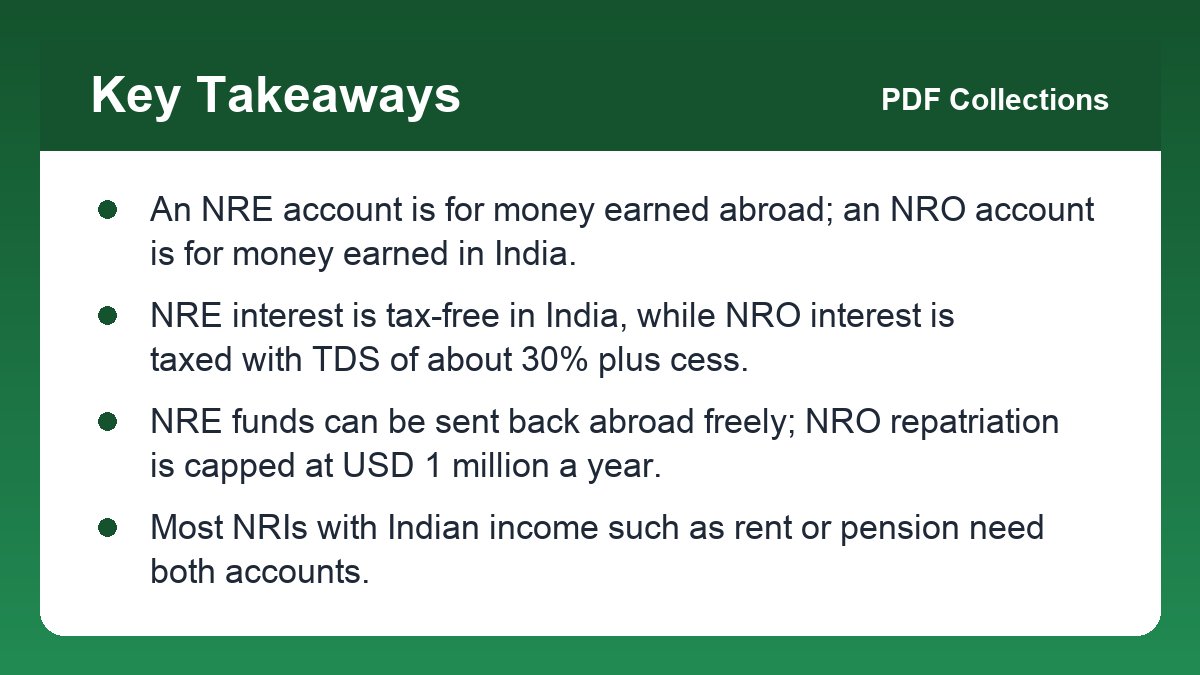
- An NRE account is for money earned abroad; an NRO account is for money earned in India.
- NRE interest is tax-free in India, while NRO interest is taxed with TDS of about 30% plus cess.
- NRE funds can be sent back abroad freely; NRO repatriation is capped at USD 1 million a year.
- Most NRIs with Indian income such as rent or pension need both accounts.
Table of Contents
What Is an NRE Account?
A Non-Resident External (NRE) account is a rupee account in India for money you earned or hold outside India. Your salary from Dubai, savings from Riyadh or a bonus from London can all go into it.
- Deposits come from abroad, or from another NRE or FCNR account
- The balance is held in Indian rupees
- Both principal and interest can be sent back abroad freely
- Interest is tax-free in India while you remain non-resident
What Is an NRO Account?
A Non-Resident Ordinary (NRO) account is a rupee account for money that comes from India. Think rent from your flat in Thrissur, dividends from Indian shares, a pension, interest from old fixed deposits, or the proceeds from selling property.
- Can receive both Indian and foreign money
- Interest is taxable in India, and the bank deducts TDS
- Sending money back abroad is allowed but limited and needs paperwork
- Your old resident savings account usually gets converted into an NRO account
NRE vs NRO Account: The Key Differences
1. Source of money
NRE accepts only foreign earnings. NRO accepts both, but its main job is Indian income. If you deposit rent or Indian dividends into an NRE account, you’re breaking FEMA rules, and the bank may ask you to move it.
2. Tax on interest
NRE interest is fully exempt from Indian income tax. NRO interest is taxable, and the bank deducts TDS at 30% plus surcharge and cess, which works out to roughly 31.2% for most people. If your country has a Double Taxation Avoidance Agreement (DTAA) with India, you may be able to claim a lower rate by giving the bank a Tax Residency Certificate and Form 10F.
3. Repatriation
Money in an NRE account can be sent abroad at any time, without limits. From an NRO account, you can repatriate up to USD 1 million per financial year, after taxes, using Form 15CA and, in many cases, a chartered accountant’s certificate in Form 15CB.
4. Joint holding
An NRE account can be held jointly with another NRI. Banks also allow a resident Indian relative as joint holder on a “former or survivor” basis. An NRO account can be held jointly with resident Indians, which is handy if parents manage your Indian bills.
5. Exchange rate risk
Both accounts are in rupees. If the rupee weakens, your deposit is worth less in dirhams or dollars when you send it back. If you want to avoid that, look at an FCNR (B) deposit, which is held in foreign currency.
6. Fixed deposit rates
Both accounts allow fixed deposits. NRE FDs have a minimum tenure of one year. Rates are often similar, but the after-tax return on an NRE FD is usually much higher because the interest isn’t taxed in India.
7. Typical uses
NRE: parking foreign savings, family support, investments in Indian mutual funds or shares on a repatriable basis, home loan EMIs. NRO: collecting rent, pension and dividends, paying Indian bills, receiving sale proceeds.
A Quick Example
Ravi works in Doha and earns in riyals. He sends ₹1 lakh a month home. He also owns a flat in Kozhikode that earns ₹18,000 a month in rent.
- His salary transfers go into his NRE account. The interest on his NRE fixed deposit is tax-free in India.
- The rent goes into his NRO account. His tenant deducts TDS on rent payments to a non-resident, and Ravi files an Indian tax return to claim back any excess tax.
- His mother is a joint holder on the NRO account so she can pay the flat’s property tax and maintenance.
That’s the most common setup I see among Gulf families, and it works well.
Do You Need Both Accounts?
If you have any income in India, rent, pension, dividends or interest, the answer is almost always yes. Keep the NRE account for foreign earnings and the NRO account for Indian income. Mixing them creates tax headaches and compliance risk.
If you have no Indian income at all, an NRE account alone may be enough for now. You can open an NRO account later.
Tax Filing Tips for NRIs
- You need to file an Indian income tax return if your taxable Indian income exceeds the basic exemption, or if you want a refund of excess TDS.
- NRE interest doesn’t need to be taxed, but it’s sensible to keep statements in case of questions.
- Check your Form 26AS and Annual Information Statement (AIS) on the income tax portal to see all TDS deducted.
- If you live in a country with income tax, report your Indian income there as required. Gulf countries generally have no personal income tax.
Opening the Accounts
Most Indian banks let you open both accounts online from abroad, through a branch in India, or through their overseas representative offices in the Gulf. You’ll typically need:
- Passport with a valid visa or residence permit
- Overseas address proof
- PAN card, or Form 60 if you don’t have one
- Recent photographs
- A cheque or transfer from an overseas account to fund the NRE account
Choose a bank with a good mobile app, low remittance charges and a branch near your family home. Those three things matter more than a slightly higher FD rate.
Common Mistakes NRIs Make
- Continuing to use a resident savings account after moving abroad
- Depositing rent or Indian income into an NRE account
- Not claiming DTAA benefits and paying more TDS than needed on NRO interest
- Forgetting to convert accounts back to resident status after returning to India
- Not adding a nominee, which makes things hard for the family later
The Bottom Line
The NRE vs NRO account question becomes simple once you remember the rule: foreign earnings in NRE, Indian income in NRO. Most NRIs end up needing both. Set them up properly in your first few months abroad and you’ll save tax, avoid compliance trouble and make life easier for your family back home.
If you’re planning longer-term savings for your return, also read our guide to the Kerala Pravasi Pension scheme, which many Gulf workers can join.
Sources and Further Reading
Frequently Asked Questions
Can I transfer money from an NRO account to an NRE account?
Yes, but it counts as repatriation. You can move up to USD 1 million per financial year from NRO to NRE or abroad, after paying applicable taxes and submitting Forms 15CA and, where needed, 15CB.
Is interest on an NRE account taxable?
Interest on NRE savings and fixed deposits is tax-free in India while you are a non-resident under FEMA. It may still be taxable in your country of residence, for example in the US, UK or Canada.
Can I deposit my Indian rent into an NRE account?
No. Rent, dividends, pension and other Indian income must go into an NRO account. An NRE account can only receive money earned or held outside India, plus transfers from other NRE or FCNR accounts.
What should I do with my resident savings account after becoming an NRI?
You must inform the bank and convert it to an NRO account once you become an NRI. Continuing to operate a resident savings account as an NRI is not allowed under FEMA.
What happens to NRE and NRO accounts when I return to India for good?
Once you return permanently, you must inform the bank and convert the accounts to resident accounts, or move NRE funds to a Resident Foreign Currency (RFC) account. Interest on NRE deposits stops being tax-free after you become resident.
This article is for general information only and is not insurance, financial or legal advice. Coverage, prices and rules vary by insurer and location, so always check your policy documents or talk to a licensed agent before making a decision.
1 thought on “NRE vs NRO Account: Which One Should an NRI Open, and Why You Probably Need Both”