In most Kerala homes, gold isn’t just jewellery. It’s the family’s emergency fund. When my aunt needed ₹1.5 lakh for my cousin’s college admission at short notice, she didn’t fill in a single loan form at a bank. She took two bangles and a chain to a branch near her house and walked out with the money in under an hour. That speed is exactly why a gold loan is so popular across India.
But speed shouldn’t stop you from understanding what you’re signing. The RBI has changed several rules recently, and these affect how much you can borrow and how lenders must treat your gold. Here’s a plain-English guide.
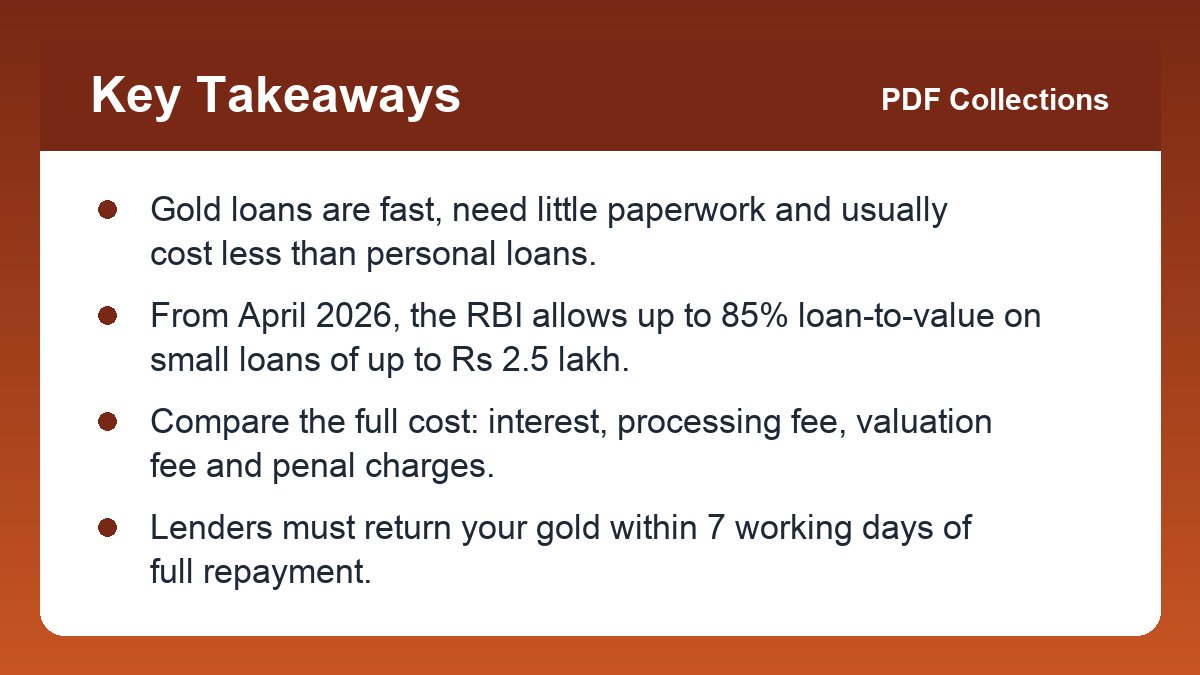
Key Takeaways
- Gold loans are fast, need little paperwork and usually cost less than personal loans.
- From April 2026, the RBI allows up to 85% loan-to-value on small loans of up to ₹2.5 lakh.
- Compare the full cost: interest, processing fee, valuation fee and penal charges.
- Lenders must return your gold within 7 working days of full repayment.
Table of Contents
What Is a Gold Loan?
It’s a secured loan where you pledge gold jewellery with a bank or NBFC. The lender checks its purity and weight, values it and lends you a percentage of that value. You repay with interest and get your gold back. If you don’t repay, the lender can eventually auction the gold to recover its money.
Because the loan is fully backed by gold, lenders don’t worry much about your income or credit score. That’s why approval is quick and paperwork is light.
How Much Can You Borrow? The New RBI LTV Rules
The key number is the loan-to-value (LTV) ratio, the maximum loan as a share of your gold’s value. Under the RBI directions on lending against gold that apply from April 2026, the limits are tiered:
- Loans up to ₹2.5 lakh: up to 85% of the gold’s value
- Loans above ₹2.5 lakh and up to ₹5 lakh: up to 80%
- Loans above ₹5 lakh: up to 75%
For loans where you pay everything (interest and principal) at the end, the LTV is calculated on the total amount you’ll owe at maturity, not just the money you take home. So the cash you actually get may be a bit lower.
The gold is valued on its purity, usually checked against 22-carat standards, using a reference price such as the average closing price published by the India Bullion and Jewellers Association. Stones, enamel and wastage aren’t counted.
Gold Loan Interest Rates and Charges
Rates vary widely. Public sector banks often charge the least, followed by private banks, with NBFCs usually a bit higher but quicker and more flexible. Rates also depend on the scheme you choose: lower LTV schemes often carry lower interest.
Besides interest, look for:
- Processing fee: a small percentage or a flat fee
- Valuation or appraisal fee
- Penal charges for late payment
- Auction charges if things go wrong
- Prepayment or foreclosure charges, which many lenders don’t charge, but check
Ask for the Key Fact Statement (KFS). It shows the all-in annual percentage rate, which makes it easy to compare offers.
Repayment Options
Regular EMI
You pay principal and interest every month, just like any other loan. This keeps the total interest lowest.
Interest-only, principal at the end
You pay interest monthly or quarterly and repay the principal at maturity. Useful if you expect a lump sum, like a bonus or a crop payment.
Bullet repayment
You pay principal and all interest together at the end, usually within 12 months. Simple, but interest builds up, and the RBI now limits how much you can borrow under this option because of the LTV-at-maturity rule.
Gold Loan vs Personal Loan
- Speed: gold loans are often disbursed in under an hour, while personal loans can take days.
- Cost: gold loans are generally cheaper than unsecured personal loans.
- Credit score: gold loans are easier with a weak or thin credit history.
- Risk: with a gold loan, you can lose family jewellery if you default. A personal loan default hurts your credit but doesn’t take your gold.
For short-term needs of a few months, a gold loan is often the smarter choice. For longer borrowing, compare alternatives like a post office personal loan or a scheme like MUDRA loan if it’s for a small business.
Your Rights Under the RBI Rules
- Clear valuation: the lender must assess purity and weight in your presence and record it.
- Proper documentation: you should get a loan agreement and a pledge receipt describing your gold.
- Return within 7 working days: once you repay fully, the lender must return your gold within 7 working days, and pay compensation for each day of delay caused by the lender.
- Fair auction: if the gold has to be auctioned, you must get notice first, and any surplus after clearing dues should be paid to you.
- Limits on pledged gold: there’s a cap on how much gold jewellery one borrower can pledge, and raw gold or bars aren’t accepted.
Smart Tips Before You Pledge
- Borrow only what you need. Just because you can get 85% doesn’t mean you should.
- Compare at least two lenders. Check banks too, not just the nearest NBFC branch.
- Choose a regulated lender. Use a bank or RBI-registered NBFC. Avoid unregistered pawn shops and informal lenders.
- Watch gold prices. If prices fall sharply, the lender may ask you to add gold or repay part of the loan.
- Keep every receipt. Your pledge receipt is proof of what you handed over.
- Repay or renew on time. Don’t let the loan run past maturity without speaking to the lender.
- Inspect the gold on return. Check weight and condition before signing the release.
- Use the loan for needs, not wants. Medical bills, education and short business gaps are sensible uses.
Mistakes I’ve Seen People Make
- Renewing the same loan year after year, paying only interest, and never actually clearing it.
- Pledging jewellery with sentimental value for something non-urgent.
- Choosing a lender only because it’s close by, without checking the rate.
- Ignoring notices about falling gold prices.
The Bottom Line
A gold loan is one of the quickest and cheapest ways to raise money in India, especially for short-term needs. The new RBI rules give small borrowers a higher LTV and better protection for their gold. Compare the full cost, borrow sensibly and have a clear plan to repay. Then your family’s gold does its job as a safety net and comes back home where it belongs.
Sources and Further Reading
- Reserve Bank of India: Directions on lending against gold collateral
- RBI Sachet: report unauthorised lenders
Frequently Asked Questions
How much can I borrow against my gold?
Under the RBI directions that apply from April 2026, lenders can lend up to 85% of the gold's value for loans up to ₹2.5 lakh, 80% for loans between ₹2.5 lakh and ₹5 lakh, and 75% for larger loans. The value is based on the purity of the gold and a reference price, not on what you paid at the jeweller.
Does my credit score matter for a gold loan?
Much less than for a personal loan, because the gold secures the loan. Some lenders still check your CIBIL score, and repaying a gold loan on time can help build your credit history.
What happens if I can't repay my gold loan?
The lender will send reminders and notices first. If you still don't pay, it can auction the gold after giving proper notice. Any amount left after recovering the dues should be returned to you. Talk to the lender early about renewal or part-payment if you're struggling.
Can I pledge gold coins or bars?
Banks and NBFCs lend mainly against gold jewellery. Gold coins sold by banks can be pledged within a limit, but raw gold, bars and gold-backed financial products like ETFs are generally not accepted under RBI rules.
How quickly will I get my gold back after repaying?
RBI rules require the lender to return the pledged gold within 7 working days of full repayment. If the lender delays for its own reasons, it must pay you compensation for each day of delay.
This article is for general information only and is not insurance, financial or legal advice. Coverage, prices and rules vary by insurer and location, so always check your policy documents or talk to a licensed agent before making a decision.